Positron Annihilation Lifetime Spectroscopy (PALS)
Positron Annihilation Lifetime Spectroscopy (PALS) is a powerful technique used to study atomic-scale defects and voids inside materials. For over half a century, it has been one of the key methods in positron science, widely applied to polymers, metals, alloys, and semiconductors.
The electronic environment around a positron affects how long it will live inside a material. This relationship offers important information about the microscopic structure of materials, revealing features that cannot be observed even with the most advanced microscopes.
PALS is a unique way to directly measure the size of the free-volume void in amorphous polymers. This makes it an important tool for both experimental and theoretical research.
Basic Principle: Start and Stop Signals
In a PALS experiment, the key idea is to measure the time interval between the birth and annihilation of a positron:
-
The start signal is the gamma photon emitted right after the positron is released from the source.
-
The stop signal is the gamma photon produced when that positron annihilates with an electron in the sample.
The time between these two signals corresponds to the positron’s lifetime, which reflects the type and size of the defects it encounters inside the material.
Experimental Setup
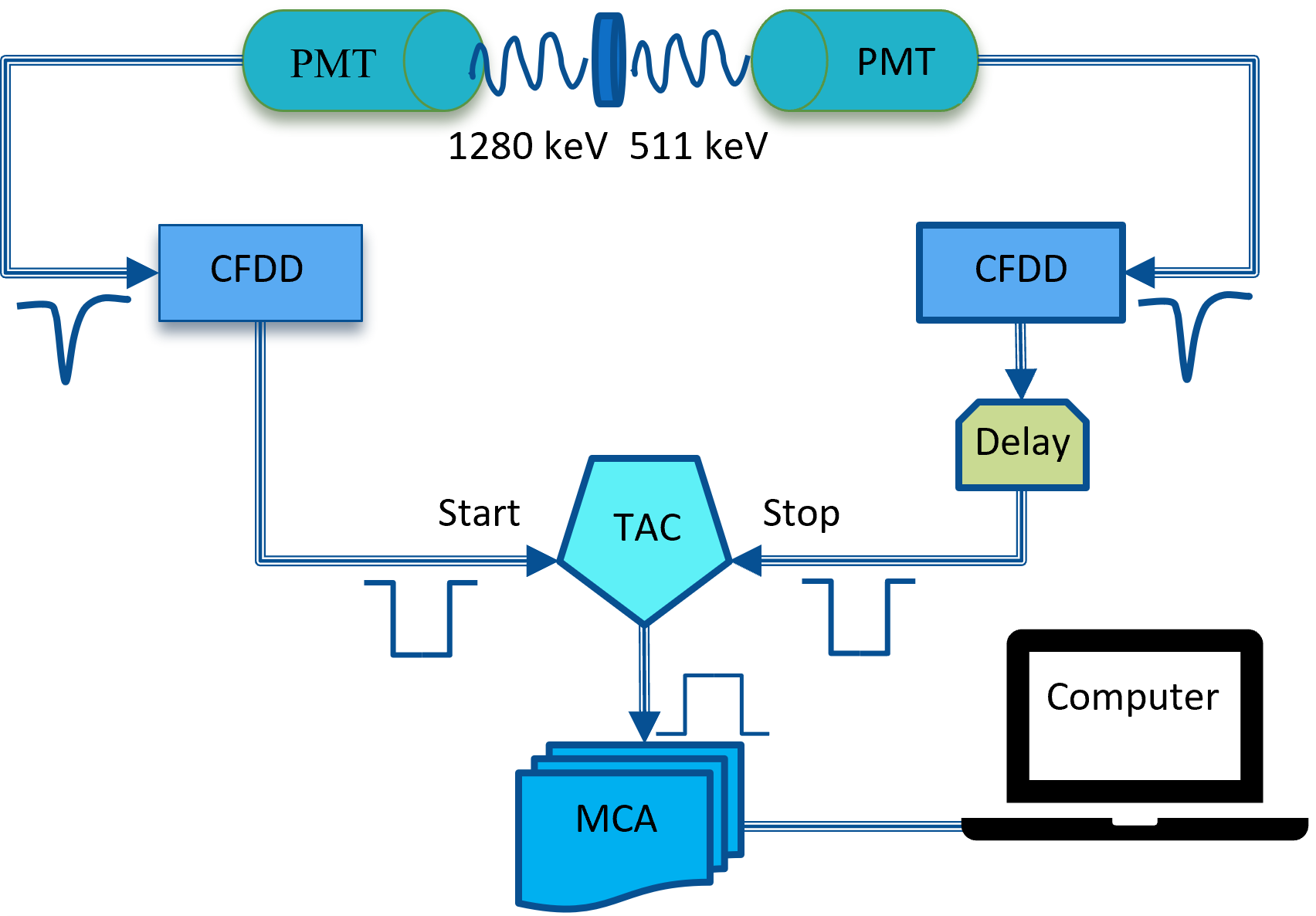
A standard PALS system consists of three main parts:
-
A positron source (usually the radioisotope Sodium-22),
-
Two gamma detectors,
-
A timing electronics system known as a fast–fast coincidence setup.
This electronic system includes components such as the Constant Fraction Differential Discriminator (CFDD), Time-to-Amplitude Converter (TAC), delay lines, and a Multichannel Analyzer (MCA) for data collection.
During an experiment, the positron source is sandwiched between two identical sample pieces and wrapped with thin metal foil. This allows positrons to enter the material efficiently and annihilate within it.
Detectors and Measurement Systems
The two detectors are usually positioned face-to-face. Each detector consists of a scintillator, a photomultiplier tube (PMT), and associated electronics.
-
The scintillator converts incoming gamma rays into visible or UV light.
-
The PMT amplifies this light and converts it into an electrical signal.
-
The signal is then filtered and timed to extract start and stop pulses.
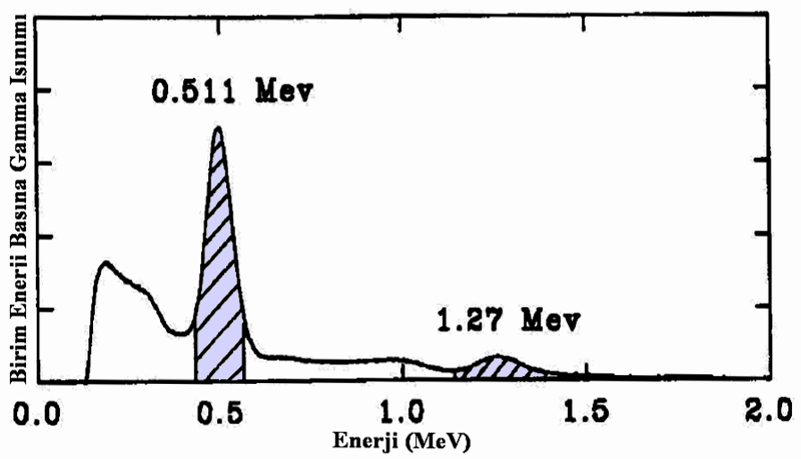
Specific energy windows are set (for example, 1.27 MeV and 0.51 MeV) to isolate the correct start and stop gamma rays. The TAC measures the time between the start and stop pulses, while the MCA records this information as a lifetime spectrum.
To obtain a statistically reliable spectrum, typically over one million annihilation events are recorded.
Mathematical Description
The measured signal as a function of time follows an exponential decay:
B(t)=∑ Ii exp(−t/τi)
Here:
-
τi: the mean lifetime of each component.
-
Ii: its corresponding intensity (probability).
Each lifetime component represents a different type of positron state or defect site in the material.
The Sodium-22 Source
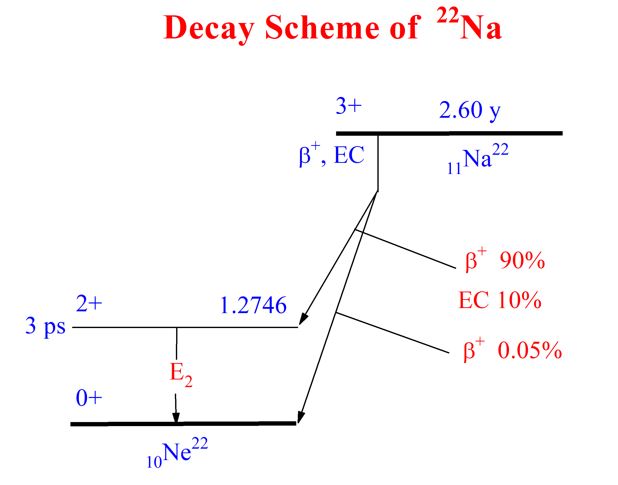
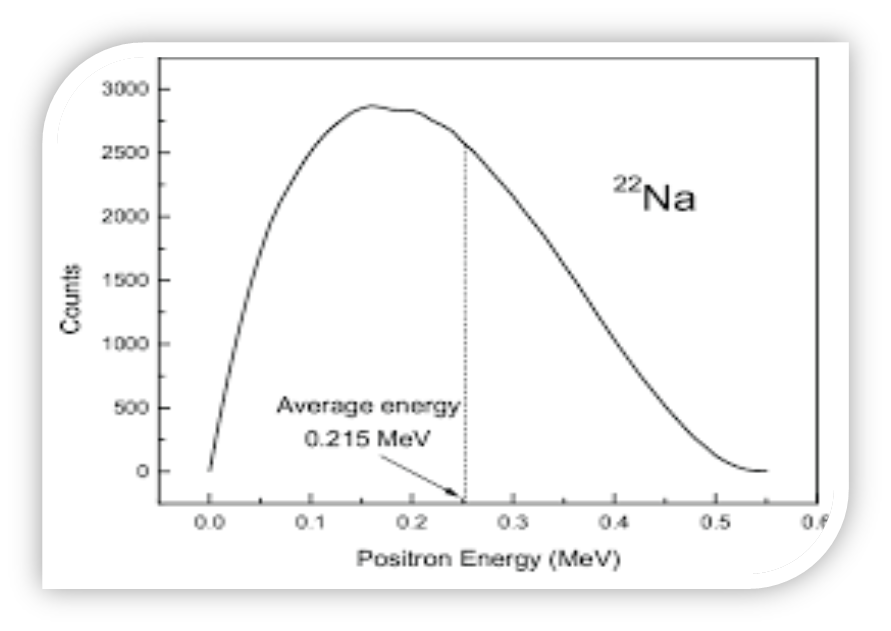
The most commonly used positron emitter in PALS experiments is Sodium-22 (²²Na). This isotope decays into Neon-22 while emitting a positron and a prompt gamma photon with an energy of 1.27 MeV:
²²Na → ²²Ne + e+ + ν + γ (1.27 MeV)
When the emitted positron encounters an electron in the sample and annihilates, it produces two gamma photons of 0.51 MeV. Thus, the 1.27 MeV photon serves as the start signal, while the 0.51 MeV photon acts as the stop signal for lifetime measurement.
Scintillator and Time Resolution
Time resolution is one of the most critical parameters in a PALS setup.
-
Plastic scintillators offer very fast response times (~140 ps) but have poor energy resolution.
-
Cesium Fluoride (CsF) provides high gamma absorption efficiency but lower timing precision (~260 ps).
-
Barium Fluoride (BaF₂) offers an excellent balance between efficiency and timing, allowing time resolutions below 180 ps with careful calibration.
The performance also depends on the quality of the photomultiplier tubes (PMTs), discriminators, and energy window adjustments, all of which require precise fine-tuning.
Summary
Positron Annihilation Lifetime Spectroscopy allows scientists to explore the atomic-scale defect structure of materials by tracking the lifetime of positrons inside them.
By By measuring how long a positron survives before annihilating, researchers can determine the sizes of voids, concentrations of defects, and characteristics of free volume in materials.
BeAs a result, PALS is a vital characterization method in materials science, nanotechnology, polymer physics, and biomaterial research.
This page updated by Pozitron/Pozitronyum Araştırma ve Hizmet Laboratuvarı on 24.01.2026 01:56:12


