Variable Energy Positron Beam System (VEPOS)
VEPOS at MARPOS enables high-precision, depth-resolved investigation of defects and free-volume structures in materials. Unlike conventional bulk PALS measurements, which average information over the entire sample thickness, VEPOS allows positrons to be implanted at controlled depths ranging from a few nanometers to several micrometers. This capability makes it a powerful tool for analyzing thin films, multilayer structures, coatings, interfaces, and irradiated materials.
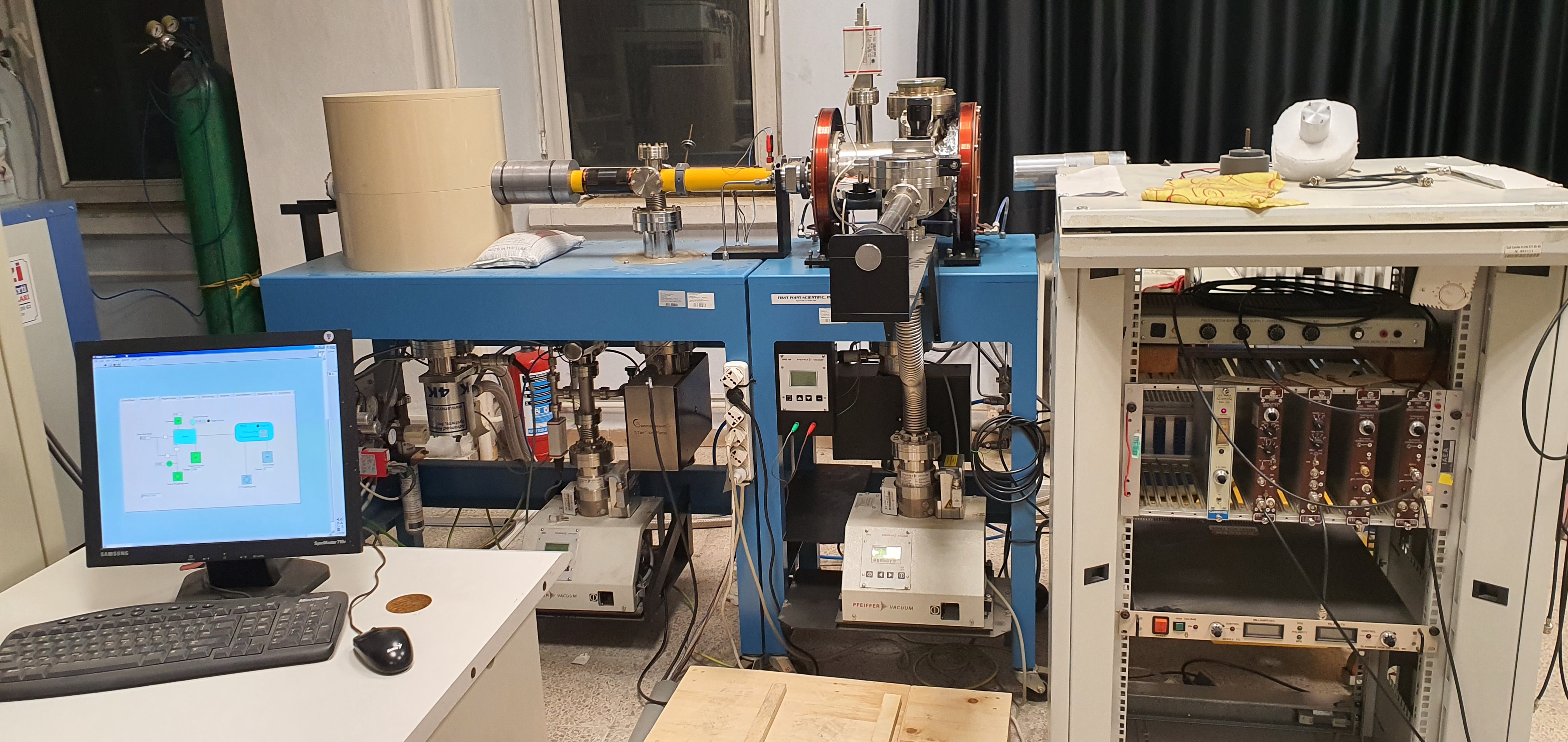
How VEPOS Works
In the VEPOS system, positrons emitted from a radioactive source are moderated via neon crystal to low energies and then re-accelerated to selectable implantation energies (typically 0.1–30 keV). By tuning the positron energy, the implantation depth can be precisely controlled:
Low energies (0.1–1 keV): top surface and near-surface region (1–10 nm)
Medium energies (1–10 keV): thin films, coatings, and interfaces
High energies (10–30 keV): micrometer-scale depth profiling
Once implanted, positrons diffuse through the material and annihilate at defect sites. The annihilation signatures—measured through Doppler Broadening Spectroscopy (DBS) or Positron Annihilation Lifetime Spectroscopy (PALS)—provide detailed information on the type, concentration, and depth distribution of vacancy-type defects.
What VEPOS Can Reveal
The VEPOS system offers unparalleled access to:
Surface and subsurface defects created during polishing, etching, or thin-film deposition
Radiation-induced damage from alpha, beta, gamma, proton, or neutron exposure
Diffusion profiles of dopants, impurities, or vacancies
Depth-dependent phase transformations in multilayer or graded materials
Interface quality in semiconductor heterostructures, oxide coatings, and perovskite films
These measurements are essential for fields such as microelectronics, battery research, thin-film technology, nanomaterials, and nuclear materials engineering.
Applications at MARPOS
At MARPOS, VEPOS is employed in several ongoing research directions, including:
Surface depth-defect profiling of thin films
Depth-resolved characterization of irradiated polymers, metals, and ceramic coatings
Investigation of diffusion and structural relaxation in complex oxide films
Quality assessment of nano-layered and composite coatings
Why VEPOS is Unique
VEPOS complements the other positron techniques at MARPOS by offering non-destructive, nanometer-scale depth resolution, making it one of the most sensitive tools for detecting open-volume defects near surfaces and interfaces—regions that are often inaccessible to other characterization methods such as SEM, TEM, or XRD.
This page updated by Pozitron/Pozitronyum Araştırma ve Hizmet Laboratuvarı on 09.12.2025 00:40:31


